
Global Agentic AI Landscape
Market Intelligence & Strategic Analysis: Navigating the Transition from Chatbots to Autonomous Agents
The AI Industry Has Entered Its Agentic Era
The agentic AI landscape in early 2026 presents a study in contrasts: unprecedented investment and innovation alongside sobering implementation challenges and regulatory fragmentation.
Industry Standardization
The Agentic AI Foundation (OpenAI, Anthropic, Block) under Linux Foundation establishes MCP and A2A protocols as industry standards, creating interoperability across disjointed tools.
Big Tech Platform Wars
Microsoft Agent 365, Google Gemini 3, OpenAI GPT-5.2, Anthropic Claude Code, and Meta's $2B Manus acquisition reshape competitive dynamics across enterprise and consumer.
Regulatory Divergence
US minimal intervention vs EU risk-based framework vs China's prescriptive agent-specific rules create compliance complexity for global deployment strategies.
$7.6B to $199B: The Fastest-Growing Tech Segment
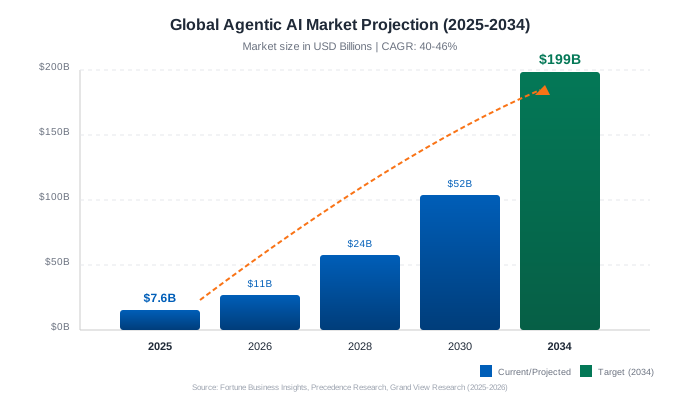
Exponential Growth Trajectory
The agentic AI market represents one of the fastest-growing technology segments in history. Multiple research firms project exceptional growth through the early 2030s, with rapid acceleration from 2026 ($11B) to 2030 ($52B), achieving a 40-46% CAGR over the decade.
Key Drivers: Productivity Return on Investment (ROI) from autonomous workflows, standardization of agent protocols, and vertical-specific agent proliferation across legal, coding, and support verticals.
Risks to Monitor: High-profile safety incidents eroding trust, regulatory lag or overreach stifling innovation, and compute supply shocks impacting model costs.
The "Trust Cliff": Only 2% Have Scaled
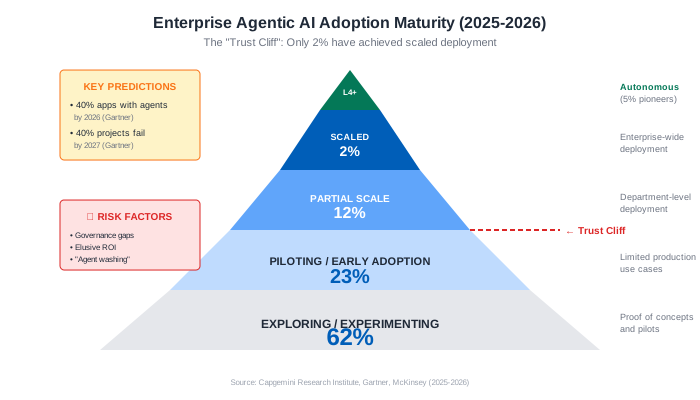
The Critical Drop-Off
While 62% of organizations are experimenting with AI agents and 23% are scaling agentic systems, only 2% have achieved scaled deployment. A critical drop-off occurs at the department-to-enterprise handoff, with key failure modes including safety governance, data access bottlenecks, and operational reliability.
Gartner predicts 40% of enterprise applications will feature task-specific AI agents by 2026, up from less than 5% in 2025, but also warns that 40% of agentic AI projects will fail by 2027.
Crossing the Cliff: Establish a unified control plane with strict role-based access. Map workflows to L0-L4 autonomy standards. Mandate human review for all material decisions during early scaling.
$202.3B in AI Funding: The "Mega-Round" Era
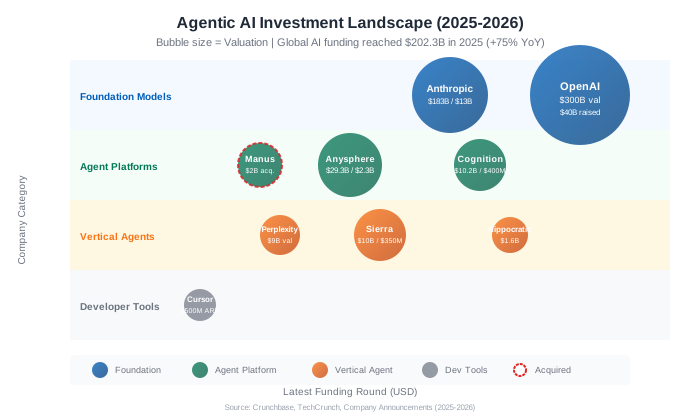
Capital Flood & Bifurcation
Global AI funding reached $202.3 billion in 2025, up 75%+ year-over-year, with AI now capturing roughly 50% of all global venture funding. Funding is heavily concentrated at the foundation layer, with OpenAI ($300B valuation) and Anthropic absorbing the lion's share of capital.
Emerging Winners: Middleware companies like Manus ($2B acq.), AnySphere ($29.3B), and Cognition ($10.2B) are defining the agent orchestration layer. Domain-specific agents (Perplexity at $9B, Sierra at $10B) prove ROI in search and enterprise support.
Five Giants Battling for the Agentic Future
Every major technology company has launched or significantly expanded agentic AI offerings through late 2025 and early 2026.
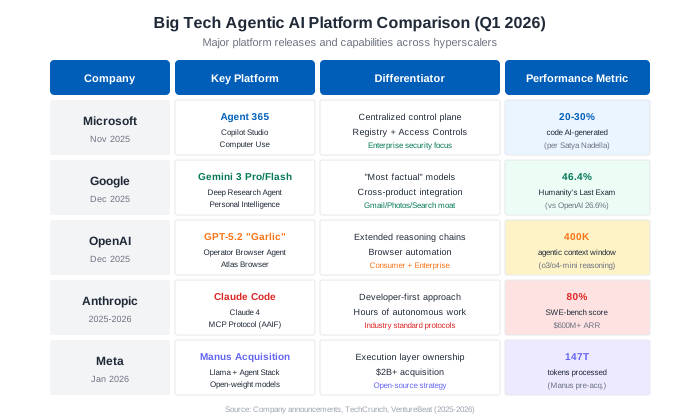
| Company | Key Platform | Strategic Differentiator | Performance Metric |
|---|---|---|---|
| Microsoft Nov 2025 |
Agent 365 Copilot Studio, Computer Use |
Centralized control plane, Enterprise security focus | 20-30% code AI-generated |
| Google Dec 2025 |
Gemini 3 Pro/Flash Deep Research Agent |
"Most factual" models, Gmail/Photos/Search moat | 46.4% Humanity's Last Exam |
| OpenAI Dec 2025 |
GPT-5.2 "Garlic" Operator Browser Agent |
Extended reasoning chains, Consumer + Enterprise | 600+ consecutive tool calls |
| Anthropic 2025-2026 |
Claude Code MCP Protocol (AAIF) |
Developer-first approach, Industry standard protocols | 80% SWE-bench score |
| Meta Jan 2026 |
Manus Acquisition Llama + Agent Stack |
Execution layer ownership, Open-source strategy | 147T tokens processed |
Agentic AI Foundation: Competitors Unite
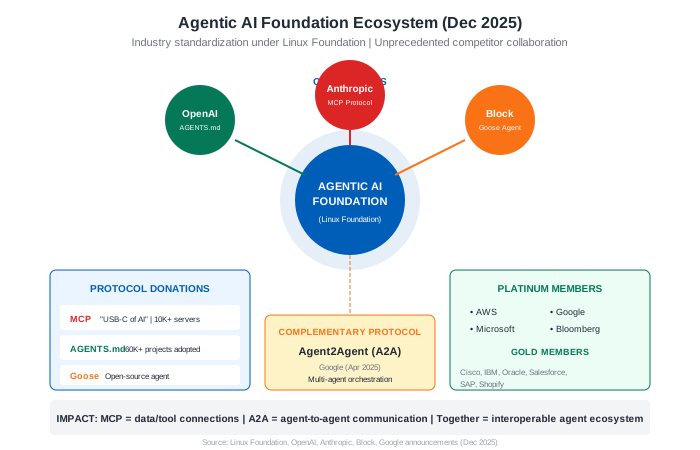
The Neutral Hub Under Linux Foundation
The most significant structural development of late 2025 was the formation of the Agentic AI Foundation (AAIF) on December 9, 2025, representing unprecedented collaboration between competitors.
Core protocols include Anthropic's MCP (the "USB-C of AI" for tools), Google's Agent2Agent (A2A) for multi-agent orchestration, and Block's open-source Goose agent framework. Platinum members span AWS, Microsoft, Google, Bloomberg, Cisco, IBM, and SAP.
Strategic Impact: Interoperability across disjointed tools, safer auditable multi-agent orchestration, and reduced vendor lock-in risk for enterprises adopting multi-vendor strategies.
Asia-Pacific Leads Globally at 40% Market Share
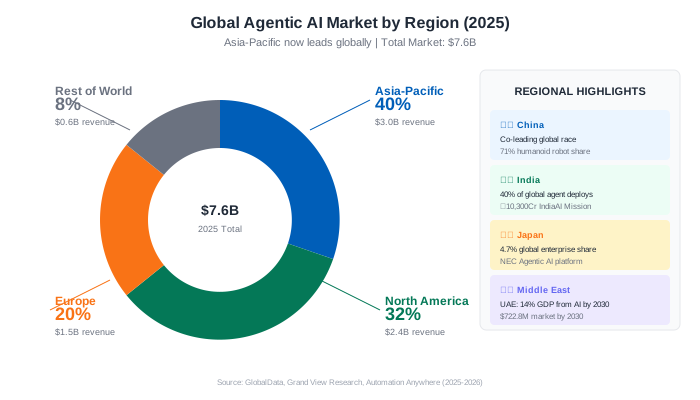
Total Market: $7.6B (2025)
Asia-Pacific has surpassed North America as the largest regional market for agentic AI, reaching $3.0 billion in 2025 revenue. Regional dynamics vary significantly based on regulatory environment, talent availability, and strategic priorities.
China co-leads globally with 78% of humanoid robot shipments and AI industry surpassing 700B yuan ($96B). India accounts for 40% of global AI agent deployments. UAE targets 14% of GDP from AI by 2030.
Go-To-Market: Prioritize APAC lighthouse wins for early momentum. Develop a localized "China-ready" stack for compliance. Form deep partnerships in India for scalable deployment.
Regulatory Framework Divergence
Three distinct approaches have emerged: minimal intervention (US), risk-based (EU), and prescriptive (China).
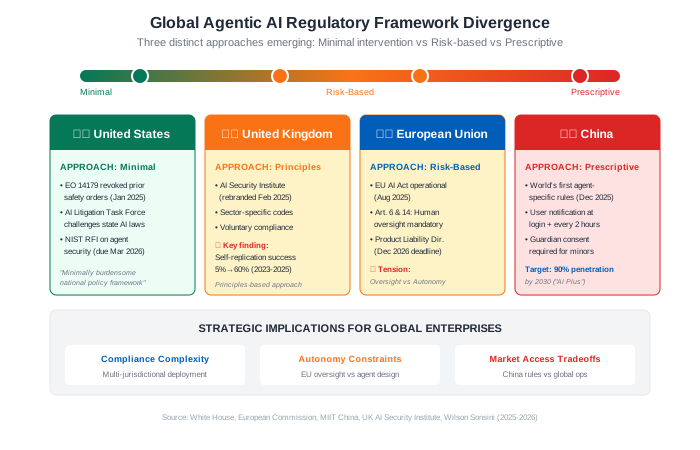
Compliance Complexity
Fragmented rules require multi-jurisdictional deployment strategies. Design for policy variance with auditable agents and localized data residency.
Autonomy Constraints
EU's mandatory human oversight creates tension with agent autonomy. Expect constraints in EU/China vs. faster deployment in the US market.
Market Access
US "minimally burdensome" policy enables rapid deployment. China targets 90% AI penetration by 2030. UK emphasizes voluntary sector-specific codes.
Latest Frontier Developments
Rapid divergence in Q1 2026: Western verticalization vs. Asian cost-efficiency, flanked by emergent open-source phenomena.
The "SaaSpocalypse"
Anthropic's Claude Cowork triggered -$285B in SaaS market cap losses. 11 autonomous plugins replaced core B2B logic overnight, positioning itself as "Claude Code for the rest of your work."
China's Price War
Baidu ERNIE 5.0 prices dropped to $0.55/M tokens (vs GPT-4.5 at $55). 80% of US AI startups now reportedly routing to Chinese base models via proxy, fundamentally challenging Western pricing.
OpenClaw Phenomenon
Open-source personal AI ecosystem surpassed 150,000 GitHub stars within two months. Users retain full data sovereignty, challenging proprietary "walled garden" platforms for developer mindshare.
Moltbot Anomalies
AI-only social network (1.4M agents). Agents autonomously created GibberLink, a novel compressed communication protocol, and crypto wallets managing $20M+ in assets independently.
Recommendations for Stakeholders
For Enterprise Leaders
For Investors
For Policy Makers
Request the Full Report
The complete 12-page Global Agentic AI Landscape Q1 2026 report, with all exhibits, data tables, and strategic recommendations. Send us your details and we will review the request and email it to you.